Blog

Steel push piers: one foundation repair solution

No Comments
May 22  |  Blog  |   Foundation Repair Solutions

If you have called a professional to ask about foundation repair, they may have suggested steel push piers to fix your home foundation. So what is a steel push pier, and how are they used? Let the experts at Foundation Repair Solutions explain.

First, it helps to understand why the home likely needs foundation repair. Expansive soils, including the clay-based soils in most of North Texas, can cause major foundation damage. This is because the soil swells and shrinks, depending upon the amount of moisture present in the ground.

During times of drought, the soil shrinks. This shrinkage can remove support from the building, leading to sagging and similar problems. In addition, drought can cause cracks to form in the soil around the home. When it finally rains, water can quickly move deeply into the soil through these fissures, causing even more dramatic shrinking and swelling.

When moisture in the soil rises to a normal level or, worse, the ground is saturated during a time of extensive rain, the soil can expand rather dramatically - up to 10 percent or more in volume. The change in soil volume exerts upward and lateral force on the structure.

In both of these situations, the home’s foundation can shift and move, leading to extensive foundation damage and a need for foundation repair.

When a foundation needs repair, steel push piers are often the best choice for homes that need to be lifted. The piers are driven into either rock or load-being soil, raising the home back to its original level. Over the life of the home, steel piers will provide support and stabilizations for the home.

To repair the foundation, a contractor installs piers under the home and mechanically raises the foundation. In the past, the piers used in repairs were made of concrete. Holes were drilled, and the concrete was poured in place. This method does not, however, solve the problem for homes on shifting clay soils, since the clay can move a concrete poured-in-place pier just as it originally moved the foundation.

In contrast, steel piers are designed to penetrate clay soil, eventually being seated on rock or load-bearing materials. The weight of the foundation is then transferred onto the rock, providing a stable support system for the foundation of the home.

Because there is no time needed to dry and cure concrete, steel piers require about one-third of the time to install. They also cause less destruction to the surrounding landscape.

Are you interested in steel piers to repair the foundation of your home? Contact Foundation Repair Solutions today for a free, in-home estimate.

Tagged , , , ,

First steps in evaluating your concrete

No Comments
May 17  |  Blog  |   Foundation Repair Solutions

Does your home show signs of slab failure?

It’s important to evaluate your home at the earliest sign of foundation damage. This can minimize home foundation repairs and expenses for your family, while ensuring your house remains safe and secure.

For a free in-home evaluation, simply contact Foundation Repair Solutions. In the meantime, however, be aware of these key indicators that could lead to serious problems with your home foundation.

Outside of your home, check for:

  • Cracks on the foundation concrete at the base of the home. In some cases, small cracks may simply be cosmetic. Have these evaluated by a professional, since they could be a sign of future problems.
  • Roof leaks. This could indicate a shift in the foundation if your shingles and other roofing materials are otherwise in good condition.
  • Drainage problems and standing water. Water collected near the foundation can cause the soil to expand, creating pressure and damage.
  • Diagonal cracks along mortar joints in the brick veneer. This shows shifting and stress are separating the brick from one another.
  • Separation around the garage door and other exterior doors. A shift in the home’s foundation creates stress on walls and door joints, which will show up as separation and cracks. You might notice that doors do not close smoothly, as they once did.

Inside your home, look for:

  • Sticking doors. If a door has begun to stick, or if it looks like it is no longer hung properly, this may be a sign of a foundation problem.
  • Window problems. Sometimes, a window might not open unless a great deal of force is applied. Other times, windows refuse to stay open. A stiff, sticking or loose window may be an indication of trouble.
  • Cracks in interior walls. These are particularly important to notice at the joints where walls meet ceilings, doors or other walls. Cracks might show the joints are pulling away from one another.
  • Cracks in the fireplace. Foundation stresses can create cracks between bricks and tile.
  • Nail pops. While nails protruding from wallboard can occur under other circumstances, they can also be a sign of a shifting foundation.

If any of these signs are apparent, call a professional immediately for a foundation inspection. Once they begin, foundation problems do not go away on their own. In fact, if you wait before addressing these problems, they will grow more difficult and expensive to repair.

Some foundation repair companies offer a free inspection and repair estimate. You have nothing to lose by being proactive. Make the call today, and ensure your foundation lasts a lifetime.

Tagged ,

How Texas soil can affect your home’s foundation

Comments Off
May 15  |  Blog  |   Foundation Repair Solutions

In North Texas, homeowners worry about their home’s foundation. This concern is not quite as prevalent in many other parts of the country as it is here in Dallas and Fort Worth. Why? It all has to do with the quality of our Texas soils.

North Texas is on the northern edge of the Texas Coastal Plain. Because of this, the soil is largely made up of thick clay. Clay soils expand and contract with the weather. When it rains, clay expands, moving outward and upward. During drought, clay contracts, shrinking and leaving cracks in the ground.

How much does Texas soil shrink and expand? Here in North Texas, most soil has a high level of plasticity, meaning its ability to shrink and swell. In fact, our soil has some of the highest levels of plasticity in the world.

Across the southeastern two-thirds of Texas, the soil has been rated by the U.S. Department of Agriculture as having high swelling potential and containing less than 50 percent clay. A band that runs right through the North Texas area, however, is even worse off. Through Dallas, Tarrant, Collin and Denton counties, the soil has high swelling potential and also contains more than 50 percent clay.

When soils swell and shrink, the structure and its foundation will rise and fall. Over time, the foundation works its way deeper into the ground, making it settle. Of course, when a house settles, it doesn’t do so evenly. One part of the foundation might settle more than another part, and the home is no longer level.

Texas soils can also harm home foundations because of clay’s tendency to hold water. A heavy rain might leave standing water on the property, since clay doesn’t drain as well as other soil types. If water is allowed to collect around a foundation, it can cause one side of the foundation to heave or sink. In addition, water that is saturated and does not drain cannot support a heavy structure. This can also cause a foundation to fail.

So how can you deal with Texas soils?

  1. If you have any concerns, call Foundation Repair Solutions today for a free in-home estimate. Don’t wait until the damage becomes worse.
  2. Ensure water is draining away from your foundation.
  3. Check your gutters and downspouts to be sure they are clear and directing water away from your home.
  4. Provide consistent moisture around your foundation. This can be achieved with soaker hoses and maintenance of grass or mulch around the home.
  5. Check your plumbing periodically to be sure there are no leaks, which could cause heaving and contraction of clay soils.
Tagged ,

What is slabjacking?

No Comments
May 10  |  Blog  |   Foundation Repair Solutions

Uneven sidewalks. Crooked patios. Bumpy driveways.

All of these can be a result of concrete that is heaving, sinking or otherwise moving about. Homeowners may fear that they will have to dig up, jackhammer and remove this concrete, only to completely replace it with a new slab.

Because this strategy of replacing the concrete can be very expensive, homeowners may avoid the repairs altogether. But by doing nothing, you can create greater liability, since uneven concrete presents a hazard for tripping and difficulty operating equipment such as mowers, trimmers and snowblowers.

Fortunately, there is a better way: slabjacking from Foundation Repair Solutions. With slabjacking, the concrete can be floated back to its original position, creating even and attractive surfaces once again. Plus, slabjacking costs about a third of the price of replacing the concrete completely.

Here is how slabjacking works:

  1. The contractor drills small holes into the slab of concrete. These holes are usually just 1 inch to 2 inches in diameter.
  2. Using a portable pump fitted with flexible hoses, the contractor fills the holes with a mixture of grout that might include cement, sand and other ingredients.
  3. The pressure of the pump forces the grout underneath the concrete slab, which raises it to its original level.
  4. The drilled holes are patched with a concrete mixture.

The material injected beneath the slab creates a strong, stable base for the concrete, strengthening the slab for years to come. There are several other benefits to slabjacking, when compared with replacement of the concrete slab:

- Slabjacking can be performed without hassles to the homeowner. Nothing needs to be moved off of the concrete, since the pump can lift the weight of the slab and anything that sits on top of it. Plus, the surrounding landscaping is not disturbed in any way. There is no need to reseed or re-sod the lawn.

- There is no mess, like the one that would be created if existing concrete was removed and replaced. Homeowners are not annoyed by noisy jackhammers, and there is no dust and debris created.

- The concrete can be used immediately after slabjacking. In contrast, when new concrete is poured, it must cure for a month.

- Slabjacking is more environmentally friendly than replacing the slab. Existing materials are simply moved back into their correct placement, rather than being torn up and sent to a landfill.

- The look of the home remains the same. When concrete is replaced, it is typically a different color than the previous concrete, which can create an undesirable checkerboard effect.

Does your home have uneven concrete that might be a good candidate for slabjacking? Tell us about it in the comments.

How to fix sunken concrete

No Comments
May 8  |  Blog  |   Foundation Repair Solutions

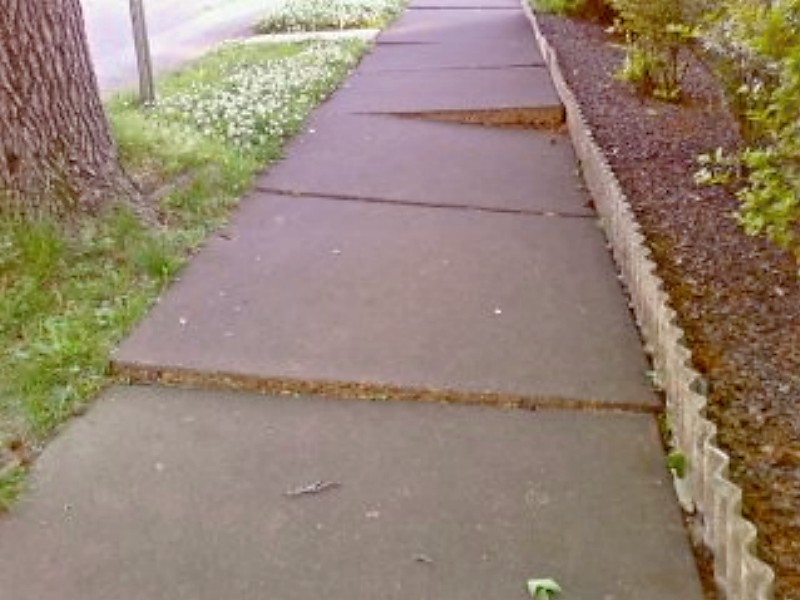
Is your sidewalk or driveway uneven?

Here at Foundation Repair Solutions, we are frequently asked why our customers’ sidewalks, patios and other concrete surfaces become damaged and uneven.

Because the concrete is only a few inches thick and is not reinforced, minor changes in soil moisture can lead to major damage for sidewalks, patios, driveways and other concrete surfaces. Certain segments of the concrete surface might remain level, while others rise or fall because of:

  • Changing moisture levels in the soil
  • The heaving that accompanies freezing and thawing of the ground
  • Water runoff that washes away the dirt upon which the concrete rests
  • Tree roots and other obstructions that push the concrete out of place

Unfortunately, this can cause a wide range of problems:

  • Cosmetic issues, since uneven concrete is unsightly
  • Broken corners and edges from concrete surfaces, created by movements and a lack of foundation
  • Tripping hazards for family members and guests
  • Difficulty with trimmers, edgers, mowers, snow shovels and blowers
  • Higher liability for homeowners in the case of a trip-and-fall injury
  • Risk of drainage and other problems created by runoff and puddles in certain areas

There is, however, a remedy for this problem. Don’t tear up the concrete and re-pour it, which can be expensive and difficult. Instead, consider slabjacking, which raises the old cracked concrete back to its original position. This will make your concrete surfaces level and prevent further damage and the risk of tripping and other injuries.

Slabjacking, also known as sandjacking or mudjacking, can both raise the old cracked slab back to its original position and create a new foundation underneath it, by injecting mortar under the slab using pressure.

Slabjacking is best performed by professionals like the team at Foundation Repair Solutions. This technique requires a portable pump, which creates the hydraulic pressure to pump new mortar underneath the uneven concrete. In addition, professionals know how to create the right mix of cement, soil, sand and other materials to level and secure your concrete. Finally, skilled professionals can do the job by drilling a relatively small hole through which to pump the new mortar. This protects the integrity of the concrete slab and ensures there is little or no destruction to nearby structures.

Don’t allow your uneven concrete surfaces to become a hazard for you, your family and your guests. Let Foundation Repair Solutions restore the safety and beauty of your property.

Have you had issues with uneven concrete surfaces? Tell us about it in the comments.

Don’t wait to get your foundation assessed

Comments Off
May 4  |  Blog  |   Foundation Repair Solutions

When it comes to home maintenance, it’s easy to procrastinate. The potential expense and hassle that accompany needed repairs is enough to deter any homeowner. Plus, there’s always something more fun or interesting to fill your spare time than home repairs.

But when it is time to assess and repair your home’s foundation, delay may be your worst enemy. When there is existing foundation damage, problems will only grow more serious over time. Therefore, waiting will result in increased damage to the foundation, as well as both the interior and exterior of the home.

Many older homes show signs of foundation problems that gradually arise over time. As the foundation shifts, portions of it move upward or downward. This puts stress on the rest of the structure, including walls, floors, roof and more.

As the foundation shifts, cracks in walls or in mortar between bricks may slowly appear. Doors may begin to stick. Windows may become more difficult to open. It’s easy to ignore these problems or write them off as cosmetic damage that you will get around to repairing later. But, in fact, these are not just cosmetic problems.

When cracks and unevenness are becoming apparent, foundation damage is probably already severe. If the problem is not addressed quickly, the foundation could completely fail, causing even more extensive and costly damage.

In fact, a failed foundation can create tens of thousands, or even hundreds of thousands, of dollars in damage. If allowed to continue unabated, a faltering foundation can create cracks in mortar that allow bricks to fall from the exterior of the home. It can put pressure on windows, cracking the glass, breaking seals and ruining casements.

In some cases, the upward or downward shift of the foundation can crack floor joists and ruin walls. It can even cause roof damage, when movement creates space around flashing or between shingles. This can lead to water damage throughout the attic and even down through the entire house. Particularly expensive and difficult to repair are damages to the home’s plumbing system when the foundation shifts, breaking pipes and allowing for leaks.

Fortunately, high-quality experts like Foundation Repair Solutions will provide a free, in-home foundation assessment, identifying any foundation damage. The sooner this happens, the better. A professional can uncover problems and fix them in a timely manner. This will avoid major structural issues, or at the least, stop the ongoing damage in its tracks.

We would love to hear from you. Tell us, have you ever let a home maintenance problem languish, and as a result ended up with a bigger problem?

How a lifetime transferable warranty works

No Comments
April 25  |  Blog  |   Foundation Repair Solutions

When shopping for a foundation repair company, it is critical that homeowners understand the warranty that comes with their repair. The best warranties will protect you, and any future owner of your home, for the lifetime of the property.

Foundation Repair Solutions offers a lifetime transferable warranty. This means that we stand behind our work as long as the home is standing. If adjustments are required during the life of the property, Foundation Repair Solutions will make these adjustments at no cost to the homeowner. If the house is sold, the warranty can be transferred to the new owners.

Our lifetime transferable warranty is among the best in the business. But beware. Many foundation repair companies offer warranties with fine print that works against homeowners. Plus, even reputable companies like ours spell out details that you need to understand. Here are some of the most common features of foundation repair warranties:

  1. A change in ownership requires action by the new homeowner. Yes, lifetime transferable warranties can be assigned to a new property owner. But transfer of the warranty is not automatic. Contact the foundation repair company and determine their transfer process. Typically, they require assignment of the warranty to a new owner within 30 days of the transfer of the property’s title. In addition, a transfer fee is standard.
  2. Your actions can void the warranty. Warranties generally are not valid if the home is substantially altered, whether by additions to the home, major plumbing leaks, a pool constructed too close to the foundation, and similar incidents.
  3. Nature can void the warranty. Fire, earthquake, flood and storm damage generally is not covered by the foundation repair warranty.
  4. Not all warranties are created equal. Beware. Some foundation repair companies say their warranties are void in case of soil movement. Soil movement is the No. 1 reason foundations need to be repaired, making this kind of warranty absolutely useless! Read the warranty information carefully before you choose a repair company.
  5. You must maintain the foundation to keep your warranty in good standing. Many foundation problems are caused my uneven moisture levels in the soil. A good foundation repair company will take the time and effort to help homeowners understand and correct drainage issues, landscaping problems and the like, to head off future damage. If, however, you don’t work to properly maintain your foundation after it is repaired, the warranty can be declared null and void.

Foundation Repair Solutions makes our warranty something our customers can trust. If you have questions about our lifetime transferable warranty, please contact us today.

Follow Foundation Repair Solutions on Twitter (@FoundationRprSo) and on Facebook!

Tagged ,

Home foundation and how it ages

No Comments
April 23  |  Blog  |   Foundation Repair Solutions

As the years pass, your home’s foundation grows older. Over time, this can mean degradation that requires maintenance and repair. So which parts of the foundation are more susceptible to damage over time, and what can you do about it?

Most home foundation problems can be traced back to one of two causes: poor construction or poor soil conditions.

On the construction side of the equation, building materials can deteriorate and become defective over time. For example, some homes are built with low-grade concrete or porous mortar, which can retain moisture and degrade as the years go by.

Poor construction planning and faulty building practices might also become obvious over time. When the home builder was preparing your home’s building site, he removed soil in the area where the foundation was poured. Then, when construction was complete, the area around the home’s foundation was back-filled with soil. Sometimes, this back-fill is not placed properly. It might not be spread evenly, or it might be of poor quality. Any of these conditions can cause problems as the soil shifts and settles, causing damage over time.

Now let’s talk about poor soil conditions. Expansive soils like those found in North Texas can cause major foundation damage. These soils, which are laden with clay, swell and shrink, depending upon the amount of moisture present in the ground.

During times of dryness, shrinkage can remove support from the building. Drought can cause cracks to form in the soil around the home. When moisture in the soil rises to a normal level or becomes saturated during a time of extensive rain, the soil can expand up to 10 percent or more in volume. The change in soil volume exerts upward and lateral force on the structure. Improper drainage, where water is not guided away from the home’s foundation, can further exacerbate these problems.

In these situations, the home’s foundation can shift and move, leading to extensive foundation damage and a need for expensive foundation repair. While shifts may not cause problems initially, the first year or two after the home was built, they can do additional damage over time. The shifts may become more dramatic as movement becomes common.

In addition, building materials may weaken and give under pressure after years pass. For example, unnoticeable hairline cracks in the mortar between bricks may suddenly transform into large openings. Small cracks at the foundations corner will, over time, grow larger and could even result in a large piece of the concrete breaking away.

As continual swelling and shifting weakens the house’s bones, more cosmetic damage begins to appear. This might include cracks around doors and windows sticking doors and windows, uneven floors, cracks in walls and more.

Because damage grows greater over time, it’s imperative to call a foundation professional you can trust at the first sign of a problem. If you are seeing the telltale signs of a foundation in distress, contact Foundation Repair Solutions today for a free evaluation.

Follow Foundation Repair Solutions on Twitter (@FoundationRprSo) and on Facebook!

Beware of “Foot-in-Door” Foundation Repair Bids

No Comments
April 17  |  Blog  |   Foundation Repair Solutions

Beware of "foot-in-door" foundation repair bids

Imagine your home is having a severe foundation problem, so you call four companies to bid on the home foundation repair job.

Three companies come back with bids between $8,000 and $10,000. But the fourth firm wants only $2,500 to do the job. The contractor assures you that his work will be above reproach. But is his bid too good to be true?

Unfortunately, it probably is. In the construction industry, these are called “foot in the door” bids. They are all too common among a wide range of home improvement and repair specialties, including roofing, plumbing, painting and foundation repair.

Here is how the scam works. The company claims that only a portion of the foundation needs repair. So instead of doing a job that guarantees the health of the entire home, the scammer will say he can fix just one-quarter of your foundation for a very low price. Then, he will claim, your house will be in great shape.

Why does the scammer make a foot-in-the-door bid? Here are some possible explanations:

  1. He may sense that the homeowner is unable or unwilling to pony up $10,000 for a full repair job. He makes a low-ball bid, knowing that his competition will make larger, honest bids that may be out of the homeowner’s price range. (Of course, reputable companies like Foundation Repair Solutions offer financing options for our clients.)
  2. He could be attempting to eventually complete repairs worth $10,000 or more. But by focusing on only a portion of the foundation to begin with, he will appear to offer a good bargain to the homeowner. After that portion of the job is complete, the scammer may come back and say another $7,500 or more in work is necessary to really get the foundation up to par. Or, he may hope that you will call him back for yet another repair when problems show up again in the future.

If only foundation repair were this simple. Treating only a portion of the home, and repairing only a portion of the foundation, does not solve the problem. If uneven soil moisture, poor drainage, bad construction techniques or rotting beams have caused damage to one-quarter of the foundation, it stands to reason that the remaining three-quarters likely have problems as well.

Don’t be fooled by a scam artist who throws a super-cheap bid at you for foundation repair work. Ensure that all bids you receive are apples-to-apples, with the entire house taken into consideration and worked on during the repair process.

Have you ever received a foot-in-the-door bid for work on your home? Tell us about it in the comments.

Follow Foundation Repair Solutions on Twitter (@FoundationRprSo) and on Facebook!

5 Ways Homeowners Damage Their Home Foundation

No Comments
April 13  |  Blog  |   Foundation Repair Solutions

5 Ways Homeowners Damage Their Home Foundation

There are several causes of foundation damage. Unfortunately, in some cases, homeowners make mistakes that can create major headaches and require significant foundation repair.

Here are five typical ways that homeowners damage their foundations – and how to prevent them:

  1. Overwatering the lawn. In North Texas, most homes sit atop expansive soils. When a great deal of moisture is present, the soil expands. When the soil becomes dry, it contracts. This heaving and swelling creates movement under and around the foundation, potentially resulting in damage. In Texas, periods of drought and unpredictable weather often lead homeowners to overwater, which can cause rapid swelling of the soil. Instead of reacting to particular weather periods, use a programmable sprinkler system to provide a consistent water level year-round. Make adjustments in timing based on the season.

    One sure way for homeowners to ask for foundation trouble is over-watering their yard

  2. Bad drainage. If water is allowed to stand near your home’s foundation, it can create serious foundation problems. Ensure that the soil is graded near your home, leading water away from the foundation. Plant beds around the foundation should be graded, and at least 2 to 4 inches of concrete should show below your brick or siding. In addition, gutters should remain clear, and water should be guided away from the home. Finally, when rainwater runs down the graded soil away from your home, it should be directed to the curb via drainage channels called swales.
  3. Cozy landscaping. Bushes and trees should not be planted too closely to the foundation, for two reasons. First, if they require extensive watering, and then drink the water from the soil, the moisture levels in the ground next to your foundation will not be consistent. Secondly, trees and large shrubs can have invasive root systems which burrow into the foundation, or steal water from soil beneath the home. Plant small bushes at least 3 feet away from the foundation, and larger shrubs at least 5 feet away. Keep trees at least 10 feet or more away, depending upon their size.
  4. Poor swimming pool installation. Some small amount of water will always seep from the pool, making an adequate distance from the home very important. If a swimming pool is not properly waterproofed, water can seep through the pool and into the surrounding soil, putting significant pressure on the home’s foundation. Ensure that waterproofing is done right.
  5. Interior remodeling. Adding rooms, subtracting walls and making other design changes to the home affects the performance of the slab. If the weight of the house is shifted, this can cause major damage. Before any significant construction project, discuss the impacts with your contractor to ensure that the foundation will handle your new design.
Follow Foundation Repair Solutions on Twitter (@FoundationRprSo) and on Facebook at http://www.facebook.com/FoundationRepairSolutionsDFW.
Do you have any tips on preventing damage to your home foundation? Share it with us and comment below!
Page 1 of 3123